
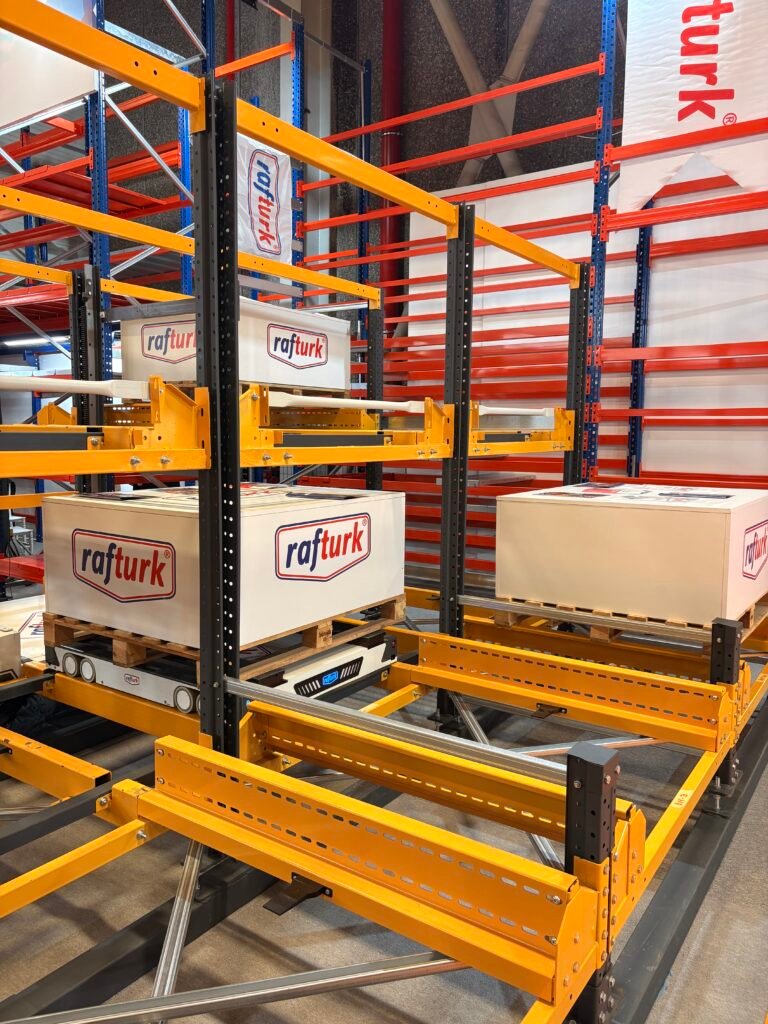
Floor space is one of the most expensive parts of a warehouse, and forklift aisles take up a large share of it. A four-way shuttle system removes most of those aisles and automates pallet storage at the same time. This guide explains how a four-way shuttle works, how it compares with a pallet shuttle and a stacker crane, where it fits best, and six checks to make before you plan one.
What is a four-way shuttle?
A four-way shuttle is a battery-powered vehicle that runs on rails inside the racking. It can move in four directions: along the travel aisles that run through the racking, and into the pallet lanes on both sides. It slides under a pallet, lifts it slightly, carries it to its position and sets it down.
One shuttle on its own is only a vehicle. A complete four-way shuttle system combines several parts:
- Racking with rails that forms the travel aisles and the pallet lanes on every level.
- Shuttles that carry the pallets on each level.
- Vertical lifts that move shuttles and pallets between levels.
- Input and output stations, fed by forklifts or conveyors.
- Charging stations for the shuttle batteries.
- Control software that assigns every pallet position and sends each task to a shuttle.
How a four-way shuttle system works
Every pallet movement runs automatically, from the input station to the storage position and back:
- Input. A forklift or conveyor delivers the pallet to the input station at the front of the racking.
- Lift. A vertical lift carries the shuttle and its pallet to the target level.
- Travel and turn. The shuttle runs along the travel aisle, changes direction and enters the pallet lane.
- Store and record. The shuttle sets the pallet down, and the software records its exact position.
- Retrieval. When an order needs the pallet, the same steps run in reverse to the output station.
Because the shuttles share all the aisles on their level, any four-way shuttle can reach any pallet position on that level. When volumes grow, you raise throughput by adding shuttles instead of building new aisles.
Four-way shuttle or pallet shuttle?
Both systems store pallets in deep lanes, and the names sound similar. The difference is how much of the work is automated.
| Criteria | Four-way shuttle system | Pallet shuttle system |
|---|---|---|
| Automation | Fully automated | Semi-automated |
| Moving between lanes | The shuttle drives itself through the travel aisles | A forklift moves the shuttle from lane to lane |
| Moving between levels | Vertical lifts | The forklift places the shuttle on each level |
| Forklifts | Only at the input and output stations, or none with conveyors | Needed for every lane change |
| Best for | High density, high automation and many movements | Large batches of the same product |
A pallet shuttle system is a simpler, semi-automated first step into dense storage. A four-way shuttle system is the choice when you want the whole storage process to run without forklift drivers inside the racking.
Four-way shuttle or stacker crane?
Both are types of automated storage and retrieval system (AS/RS). A stacker crane usually serves a single aisle and reaches every level of it. Four-way shuttles share the whole system instead:
- If a vehicle stops, the other shuttles keep the system running. With a stacker crane, that aisle is out of service until the crane is repaired.
- To raise throughput, you add shuttles. With stacker cranes, you add aisles and cranes.
- In existing buildings, the racking can be designed around columns and irregular layouts. Stacker cranes work best in tall, purpose-built high-bay warehouses.
Where a four-way shuttle fits best
- Cold and frozen storage. Dense storage reduces the volume you need to cool, and cold store shuttles run down to −25 °C.
- Food and beverage. Large volumes per product with strict stock rotation.
- Third-party logistics. Capacity that grows with your customers by adding shuttles.
- Manufacturing. Raw material and finished goods buffers fed by conveyors.
- Retail distribution. Peak-season volumes without more floor space.
Technical facts of the shuttles we install
The four-way shuttles in Rafturk systems come in three load classes. Key data:
| Parameter | Value |
|---|---|
| Rated load | 1,000 kg, 1,500 kg or 2,000 kg |
| Pallet sizes | 1100–1400 × 800–1200 mm (1,000 and 1,500 kg models), up to 1600 × 1400 mm (2,000 kg model) |
| Body height | 125 mm (1,000 and 1,500 kg models), 150 mm (2,000 kg model) |
| Positioning accuracy | ±1 mm |
| Battery | Lithium iron phosphate (LiFePO4) |
| Operating time per charge | 8–10 h standard, 6–8 h cold store |
| Full charging time | About 1.2 h standard, 2.5 h cold store |
| Operating temperature | −15 to 45 °C standard, −25 to 0 °C cold store |
Safety is built in: long-range laser obstacle detection, Safe Torque Off on the drive, pallet skew detection and a dual battery management system. If a shuttle stops, a rescue tool lets technicians lift it out of the racking for repair. See the full data on our four-way shuttle systems page.
6 checks before you plan a four-way shuttle system
A good layout starts with good data. These six points decide the size, cost and performance of the system.
1. Products and pallets
List how many different products you store, how many pallets you hold of each, and the size and weight of every pallet type. Automated systems need pallets in good condition, because broken boards and overhanging loads cause stops.
2. Throughput
Count the pallets that go in and out per hour at your busiest time. This number sets how many shuttles, lifts and input stations the system needs.
3. Building
Clear height, column grid, floor flatness and floor load capacity decide how many levels and lanes fit. An existing building can often be used, but it needs a site survey first.
4. Temperature
For cold stores, the system uses cold store shuttles with a low-temperature battery. Their operating time per charge is shorter, so the number of shuttles and the charging plan are calculated for it.
5. Software and integration
The control software has to exchange data with your warehouse management or ERP system. Plan early how orders, stock data and pallet labels flow between them.
6. Fire safety and service
Dense storage affects fire protection design, so involve your fire safety consultant and the local authority at the start. Also agree on maintenance, spare parts and how the system keeps running while a shuttle is serviced.
How Rafturk delivers a four-way shuttle project
Rafturk designs and installs four-way shuttle systems on racking made in our own factory in Çerkeş, Çankırı. One team takes the project from the first survey to after-sales support:
- Site survey of your building, products and throughput.
- Layout and engineering, including the number of shuttles and lifts.
- Racking production in our factory.
- Installation by our own teams.
- After-sales support as your warehouse grows.
Frequently asked questions
Is a four-way shuttle system fully automated?
Yes. Shuttles, lifts and conveyors move the pallets under the control of the software. People or forklifts are only needed at the input and output stations, unless conveyors handle those too.
How many shuttles does a warehouse need?
It depends on your peak throughput, the number of levels and the layout. The number is calculated for each project, and more shuttles can be added later.
Can a four-way shuttle work in a freezer?
Yes. The cold store model operates between −25 and 0 °C, with a low-temperature battery.
What happens if a shuttle stops?
The other shuttles keep working, so the system stays in operation. Technicians lift the stopped shuttle out of the racking with a rescue tool and repair it.
Planning dense, automated pallet storage? Send us your building drawing and pallet data, and our engineers will prepare a layout proposal. Contact Rafturk.
