High-density storage
Drive-In Racking for High-Density Pallet Storage
Drive-in racking stores pallets on rails inside deep lanes, and the forklift drives into the lane to place and pick them. With fewer aisles, more of your building holds pallets. Rafturk designs, manufactures and installs it in our own factory in Türkiye.
How it is built
What is drive-in racking?
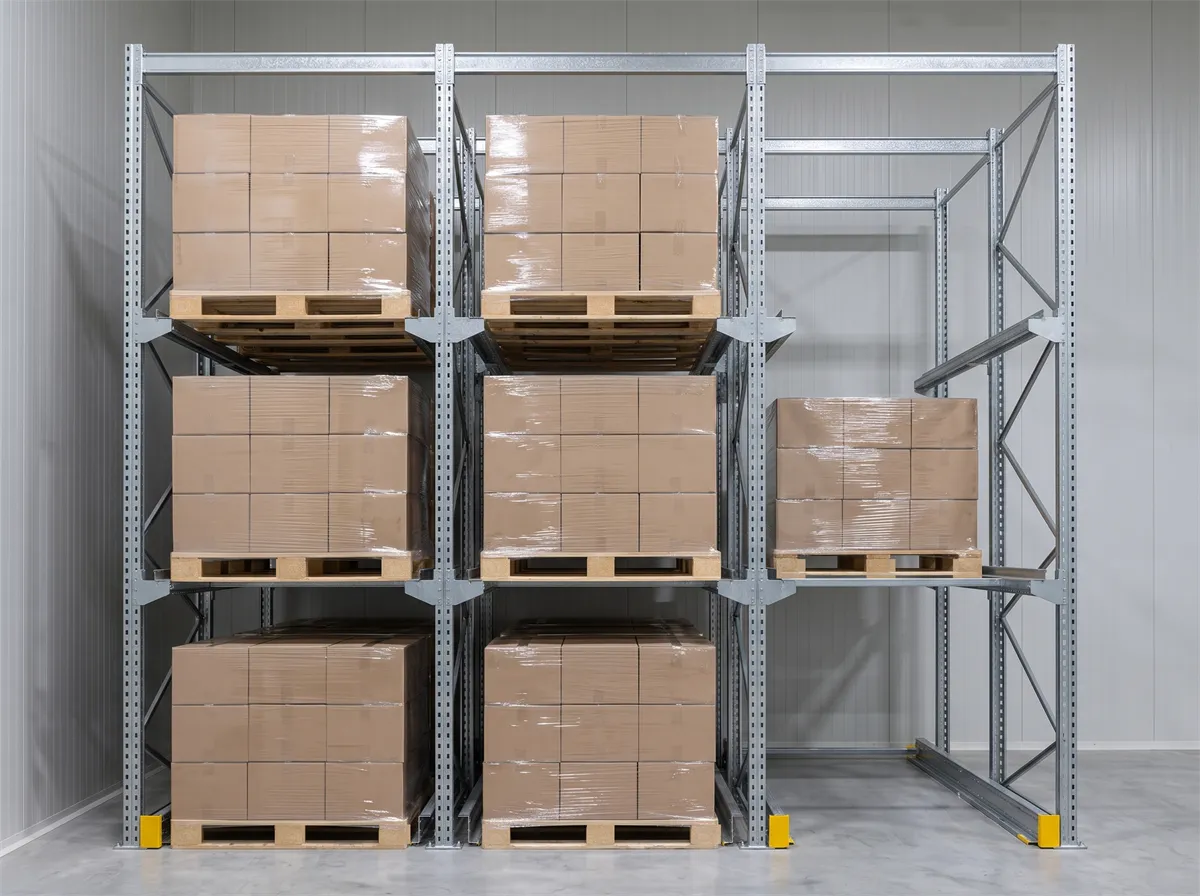
Drive-in racking is a block of storage lanes without aisles between them. Pallets rest on rails fixed to the uprights, and the forklift drives into the lane to store them one behind another.
Top tie beams
Connect the frames at the top and keep the whole block stable.
Upright frames
Form the walls of each lane and carry the load of every pallet level to the floor.
Pallet rails
Run along both sides of the lane. Each pallet rests on its edges between two rails.
Rail brackets
Fix the rails to the uprights. Their size is set by the pallet and load profile.
Floor guide rails
Keep the forklift centred at the lane entry and protect the uprights.
Layouts
Drive-in or drive-through?
The same racking works in two ways. The choice decides your stock rotation.
Drive-in: last in, first out
The block has one open side. Pallets enter and leave from the same aisle, so the last pallet stored is the first one out. This gives the highest density.
Drive-through: first in, first out
The lanes are open at both ends. Pallets are loaded from one aisle and picked from the other, so the oldest pallet leaves first.
Benefits
Why choose drive-in racking?
It turns aisle space into storage space when you hold many pallets of the same product.
- More pallets, fewer aisles. One aisle serves a whole block of storage lanes.
- Cold store friendly. Less of the cooled volume is lost to aisles.
- Standard forklifts. Trucks that fit the lane width work without special vehicles.
- Large batches. Ideal for many pallets of a few products.
- LIFO or FIFO. Drive-in from one side or drive-through from both.
- Uses the full height. Rail levels are set to your pallet heights and clear height.
Comparison
Drive-in or another dense system?
All of these store more pallets than selective racking. They differ in access, rotation and how the forklift works.
Swipe the table to see all columns →
| System | Forklift in the lanes | Stock rotation | Best for |
|---|---|---|---|
| Drive-in racking | Yes, drives into each lane | LIFO, or FIFO as drive-through | Many pallets of a few products |
| Pallet shuttle racking | No, only at the lane entry | FIFO or LIFO | Large batches with more movements |
| Narrow aisle racking | No, narrow-aisle trucks work from the aisle | Any pallet | Tall buildings with many products |
| Selective pallet racking | No, works from the aisle | Any pallet | Many products, frequent picking |
Read more about drive-in and drive-through pallet racks.
Planning
How we plan your drive-in racking
Lane depth and rail levels come from your stock and your forklift.
Products and pallets
Number of products, pallets per product, pallet size and condition.
Lane depth
Each lane holds one product, so lane depth follows the stock you keep per product.
Forklift and clearances
Truck width and mast height set the lane width and the rail levels.
Production and installation
The racking is made in our factory and installed by our teams.
Safety
Safety accessories and options
Forklifts work inside the racking, so protection is planned for every lane.
Floor guide rails
Keep the forklift centred at each lane entry.
Column guards
Protect the uprights at the lane entries.
Rail entry guides
Help the driver place pallets straight onto the rails.
Pallet stops
Stop pallets at the back of drive-in lanes.
Top tie beams
Connect the frames for a stable block.
Load signs
Show the safe working load of each lane.
Frequently asked questions
What is drive-in racking?
Drive-in racking is a high-density pallet storage system made of deep lanes without aisles between them. Pallets rest on rails fixed to the uprights, and the forklift drives into the lane to store or pick them.
What is the difference between drive-in and drive-through racking?
Drive-in lanes are open on one side only, so pallets work last in, first out. Drive-through lanes are open at both ends, so pallets are loaded on one side and picked on the other, first in, first out.
How deep can drive-in lanes be?
Each lane holds one product, so the depth follows the stock you keep per product, your pallets and your forklift. We calculate it for each project to avoid half-empty lanes.
Is drive-in racking suitable for cold stores?
Yes. It is widely used in cold and frozen storage because fewer aisles mean less cooled space per pallet.
Drive-in racking or a pallet shuttle?
Drive-in racking needs no shuttle vehicles, and the forklift places every pallet in the lane. A pallet shuttle keeps forklifts out of the lanes and handles more pallet movements, which suits higher throughput.
What information do you need for a quote?
Building dimensions and clear height, pallet sizes and weights, pallets per product and the type of forklift you use.
Related systems
Explore other warehouse racking
Pallet Shuttle Systems
Deep-lane storage where a shuttle moves the pallets and forklifts stay at the lane entry.
Explore pallet shuttle systemsSelective Pallet Racking
Direct access to every pallet, for warehouses with many different products.
Explore selective pallet rackingNarrow Aisle Racking
Narrower aisles and taller racks, with direct access to every pallet.
Explore narrow aisle rackingPlan your drive-in racking
Send us your building drawing and pallet data, and we will prepare a racking layout and quote for your warehouse.