
Warehouse racking
Selective Pallet Racking with Direct Access to Every Pallet
Selective pallet racking stores each pallet on its own beam level, so a forklift can reach any pallet straight from the aisle. Rafturk designs, manufactures and installs it in our own factory in Türkiye.
How it is built
What is selective pallet racking?
Selective pallet racking is the most common way to store pallets. Steel upright frames and horizontal beams form bays, and each pallet sits on its own level, so no pallet blocks another.
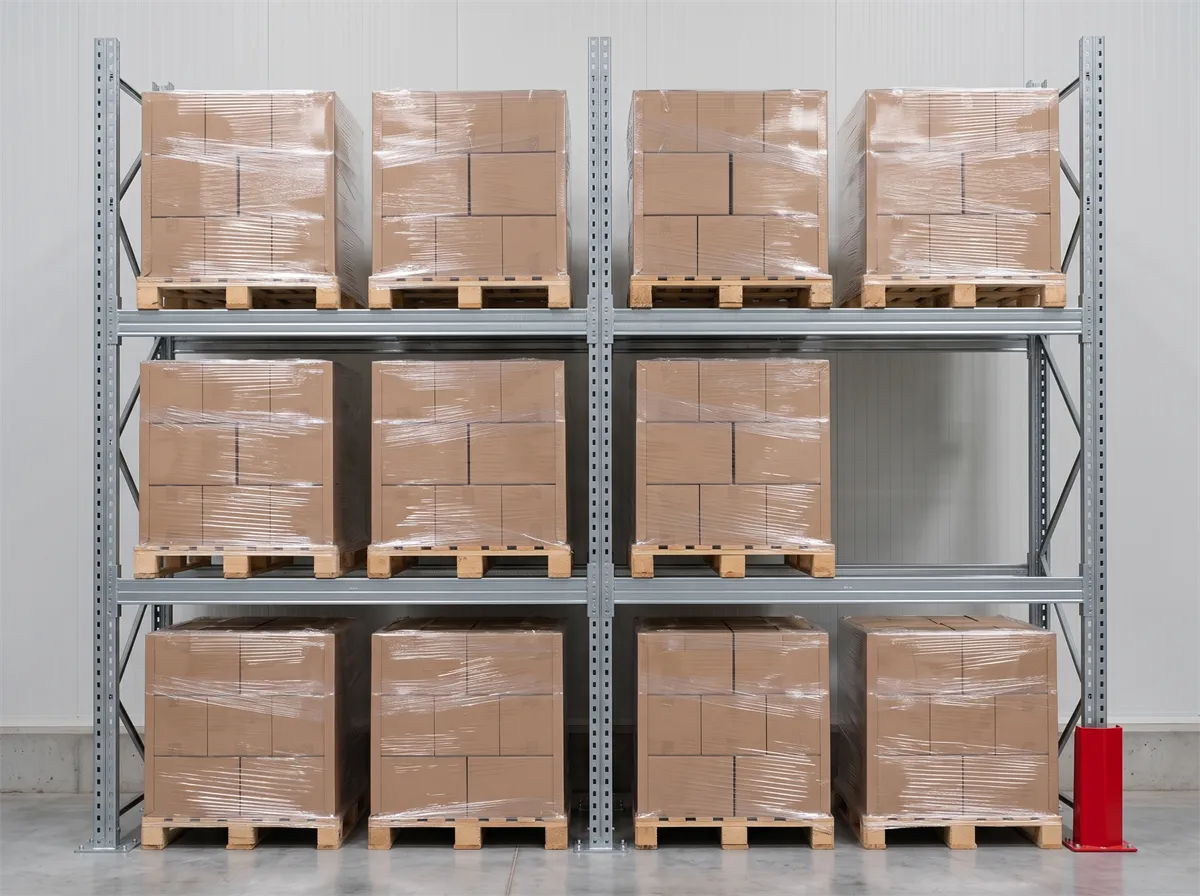
Upright frames
Steel frames with bracing that carry the load to the floor. Their perforations let you set beam levels to your pallet heights.
Beams
Horizontal members that hold the pallets at each level. The beam profile and length set the load per level.
Beam connectors and safety locks
Connectors hook the beams into the uprights, and safety locks stop them from lifting out by accident.
Column guards
Protect the uprights from forklift impact at the most exposed points.
Base plates and floor anchors
Spread the load into the floor and fix each frame in place.
Layouts
Single-sided and back-to-back rows
The same racking is arranged in two basic ways. Most warehouses combine both.
Single-sided rows
One row of racking runs along a wall and is served from a single aisle. This makes the most of the warehouse perimeter.
Back-to-back rows
Two rows are joined with row spacers and served from aisles on both sides. This is the standard layout in the middle of a warehouse.
Benefits
Why choose selective pallet racking?
It is the most flexible pallet storage system, and the starting point for most warehouse layouts.
- Direct access. Any pallet can be picked without moving another one.
- Standard forklifts. Works with counterbalance and reach trucks, with aisles sized to your fleet.
- Adjustable levels. Beam levels can be moved as your products and pallet heights change.
- Many products. Suits warehouses that store a wide range of items with a few pallets each.
- Easy to extend. Add bays or rows as the warehouse grows.
- Simple stock control. Fixed pallet positions are easy to label and manage.
Comparison
Selective racking or a denser system?
When you store many pallets of the same product, a denser system can fit more pallets in the same building.
Swipe the table to see all columns →
| System | Pallet access | Storage density | Best for |
|---|---|---|---|
| Selective pallet racking | Every pallet directly | Standard | Many products, frequent picking |
| Narrow aisle racking | Every pallet, with narrow-aisle trucks | Higher | Tall buildings with many products |
| Drive-in racking | Per lane, last in first out | High | Many pallets of a few products |
| Pallet shuttle racking | Per lane, FIFO or LIFO | Very high | Large batches per product |
Selective racking is the most widely used type of pallet racking.
Planning
How we plan your selective pallet racking
Four inputs decide the layout, the beam levels and the load capacity.
Pallets and loads
Pallet sizes, weights and the number of products you store.
Trucks and aisles
Your forklift type sets the aisle width and the highest beam level.
Layout and levels
We draw rows, bays and beam levels around your building.
Production and installation
The racking is made in our factory and installed by our teams.
Safety
Safety accessories and options
Selected for each project based on loads, trucks and traffic in the aisles.
Column guards
Protect uprights at forklift height.
End-of-aisle barriers
Shield the end frames of each row.
Row spacers
Join back-to-back rows into one stable unit.
Wire mesh decking
Supports loads that do not sit fully on the beams.
Pallet support bars
Extra support for pallets placed across the beams.
Load signs
Show the safe working load of each bay.
Frequently asked questions
What is selective pallet racking?
Selective pallet racking is the most common type of warehouse pallet storage. Upright frames and beams form bays where each pallet sits on its own level, so a forklift can reach any pallet directly from the aisle.
What is back-to-back racking?
Back-to-back racking is two rows of selective racking joined with row spacers and served from aisles on both sides. Single rows usually run along the walls, and back-to-back rows fill the middle of the warehouse.
How much weight can selective pallet racking hold?
It depends on the upright frame, the beam profile and the beam length, so capacity is calculated for each project. Every level is designed for the pallet weights you specify and shown on load signs.
Can beam levels be changed later?
Yes. Beams hook into the perforated uprights and can be moved for new pallet heights. Capacity must be checked again after a change, because the distance between levels affects what the frame can carry.
Is selective pallet racking better than drive-in racking?
It depends on your stock. Selective racking gives direct access to every pallet and suits many different products. Drive-in racking stores more pallets in the same space but works lane by lane, so it suits many pallets of a few products.
What information do you need for a quote?
Building dimensions and clear height, pallet sizes and weights, the number of products and the type of forklift you use.
Related systems
Explore other warehouse racking
Narrow Aisle Racking
Narrower aisles and taller racks for more pallet positions in the same building.
Explore narrow aisle rackingDrive-In Racking
Dense storage where forklifts drive into the lanes, for many pallets of the same product.
Explore drive-in rackingPallet Shuttle Systems
A battery-powered shuttle moves pallets inside deep lanes while forklifts stay at the entry.
Explore pallet shuttle systemsPlan your selective pallet racking
Send us your building drawing and pallet data, and we will prepare a racking layout and quote for your warehouse.