
Semi-automated storage
Pallet Shuttle Systems for High-Density Storage
A pallet shuttle is a battery-powered vehicle that moves pallets inside deep storage lanes, so forklifts only work at the lane entry. Rafturk designs and installs pallet shuttle systems on racking made in our own factory.
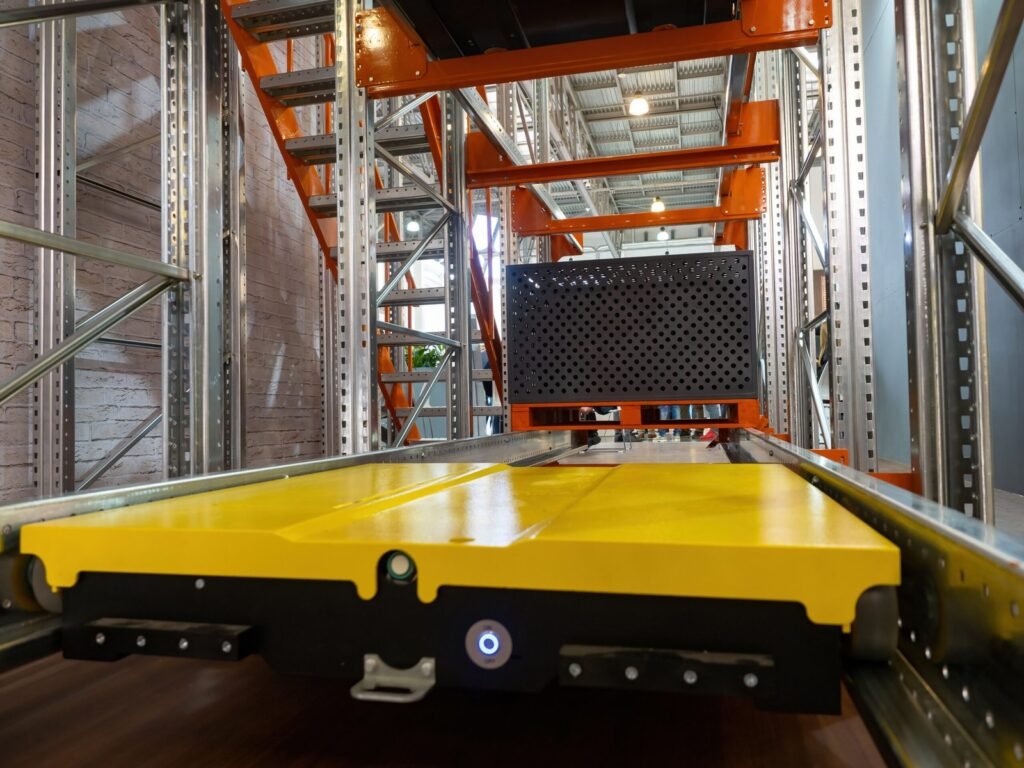
How it works
How a pallet shuttle works inside the lane
The forklift stays at the front of the racking. The shuttle does the work inside the lane.
Swipe to see the full lane →
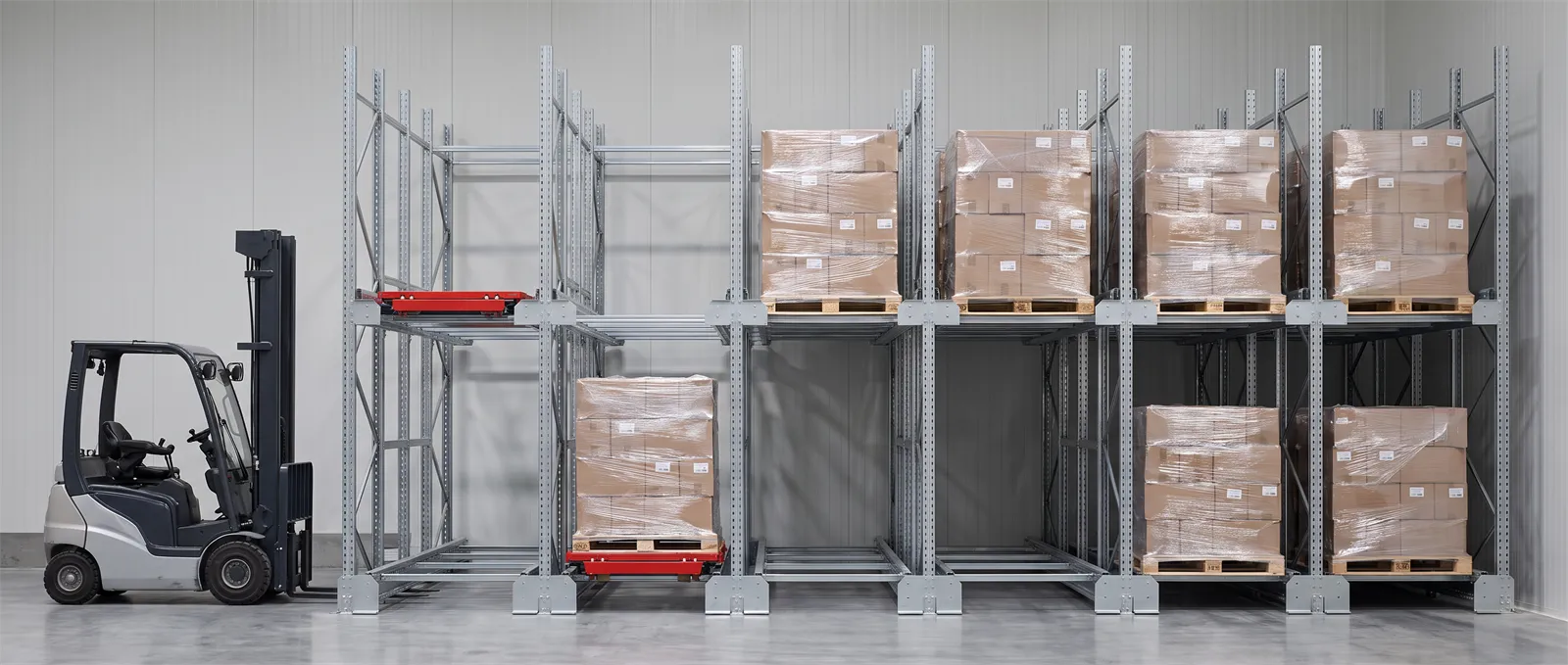
Pallet in
The forklift places the shuttle in the lane and sets each pallet at the lane entry.
Into the lane
The shuttle lifts the pallet and carries it along the rails.
Stored back to back
Pallets fill the lane from the deep end, with no aisles between them.
Ready for the next
The shuttle returns to the entry for the next pallet. Retrieval works in reverse.
Stock rotation
FIFO or LIFO: two ways to set up the lanes
The layout decides the stock rotation. Both use the same shuttle and racking.
FIFO: first in, first out
Pallets are loaded on one side of the lane and picked from the other, so the oldest pallet always leaves first. Ideal for food and products with expiry dates.
LIFO: last in, first out
Loading and picking happen from the same side, so the lane needs only one working aisle. Ideal for maximum density with non-perishable goods.
Benefits
Why choose a pallet shuttle system?
Shuttle racking stores more pallets than conventional racking while keeping your forklift fleet.
- More pallets, fewer aisles. Deep lanes replace the aisles of selective racking in the same building.
- Forklifts stay outside. No driving into the racking means less damage and safer work.
- Faster cycles. The forklift moves on while the shuttle handles the deep lane.
- FIFO or LIFO. Choose the stock rotation that suits your products.
- One forklift, several lanes. A single forklift can keep several shuttles busy.
- Cold store friendly. Dense lanes and less forklift time inside the cold room save energy.
Comparison
Pallet shuttle, drive-in or four-way shuttle?
All three store pallets in deep lanes. They differ in how pallets move and how much is automated.
Swipe the table to see all columns →
| Criteria | Pallet shuttle | Drive-in racking | Four-way shuttle |
|---|---|---|---|
| Forklifts in the lanes | No, only at the lane entry | Yes, into every lane | No forklifts in the racking |
| Storage density | High | High | Very high |
| Stock rotation | FIFO or LIFO | LIFO | Managed by software |
| Automation | Semi-automated | Manual | Fully automated |
| Racking damage risk | Low | Higher, forklifts drive in the lanes | Low |
| Best for | Many pallets per product, steady volumes | Many pallets per product, low throughput | High volumes and continuous operation |
A four-way shuttle system is a type of automated storage and retrieval system (AS/RS).
Right fit
Is a pallet shuttle right for your warehouse?
A good fit when
- You store many pallets of each product
- You need FIFO rotation for food or dated goods
- You want denser storage without full automation
- Your operation already runs with forklifts
Consider four-way shuttles when
- You need fully automated storage
- Throughput is high and continuous
- You want no forklifts in the storage area
- You plan to grow by adding vehicles
Frequently asked questions
What is a pallet shuttle?
A pallet shuttle is a battery-powered vehicle that runs on rails inside a storage lane. A forklift places it at the lane entry, and the shuttle carries pallets to the deepest free position and brings them back when needed.
What is the difference between FIFO and LIFO in pallet shuttle racking?
In FIFO (first in, first out), pallets are loaded on one side of the lane and picked from the other, so the oldest pallet leaves first. In LIFO (last in, first out), loading and picking happen from the same side, which needs only one working aisle.
How is a pallet shuttle different from drive-in racking?
Both store pallets in deep lanes. In drive-in racking the forklift drives into the lane. With a shuttle, the forklift stays at the entry and the shuttle moves pallets inside, which is faster, safer for the racking and also allows FIFO.
How is a pallet shuttle different from a four-way shuttle?
A standard shuttle works in one lane at a time and needs a forklift to move between lanes. A four-way shuttle changes lanes, and with lifts also levels, on its own, so the whole storage process is automated.
Can pallet shuttles be used in cold stores?
Yes. Shuttle racking is widely used in cold and frozen storage because it stores more pallets in the cooled volume and reduces forklift time inside the cold room. The operating temperature range is confirmed for each project.
What information do you need to prepare a layout?
Building dimensions and clear height, pallet sizes and weights, the number of products, pallets per product and daily pallet movements.
Related systems
Explore other storage solutions
Four-Way Shuttle Systems
Fully automated storage with shuttles that change lanes and levels on their own.
Explore four-way shuttlesDrive-In Racking
Dense, manual pallet storage where forklifts drive into the lanes.
Explore drive-in rackingAutomated Storage Systems
Compare the levels of automation and find the right one for your warehouse.
View automated systemsPlan your pallet shuttle racking
Send us your building drawing and pallet data, and we will prepare a layout with the right lane depth for your products.